
PACT Interviews and Workshops
Gain practical skills and learn new approaches that help you and your clients grow and thrive — even if you have not taken PACT training.
Open to all clinicians, these interviews and workshops are chock-full of useful information vital to your ongoing growth and development as a couple therapist.
If you have a PACTplus: Alumni Community Membership, these interviews and workshops are included in your membership. Please sign up in advance in your PACTplus portal for these events at no additional cost.
If you are not a PACTplus: Alumni Member, you can still register and join in! Simply sign up for each workshop using the links below.
Interviews
Join PACT developer Dr. Stan Tatkin as he interviews other experts in the field of couple therapy and delves deeper into topics related to sex issues, consensual non-monogamy, and the integration of PACT with other models of couple therapy.
In these interviews, you’ll meet a range of innovative and inspiring people who are working with couples in their own ways.
Workshops
In workshops, you’ll learn from PACT founder and other PACT faculty about experiential strategies, pioneering approaches, and practical resources that allow you to integrate new skills into everyday clinical practice and feel more confident in your work with couples.
Upcoming Events
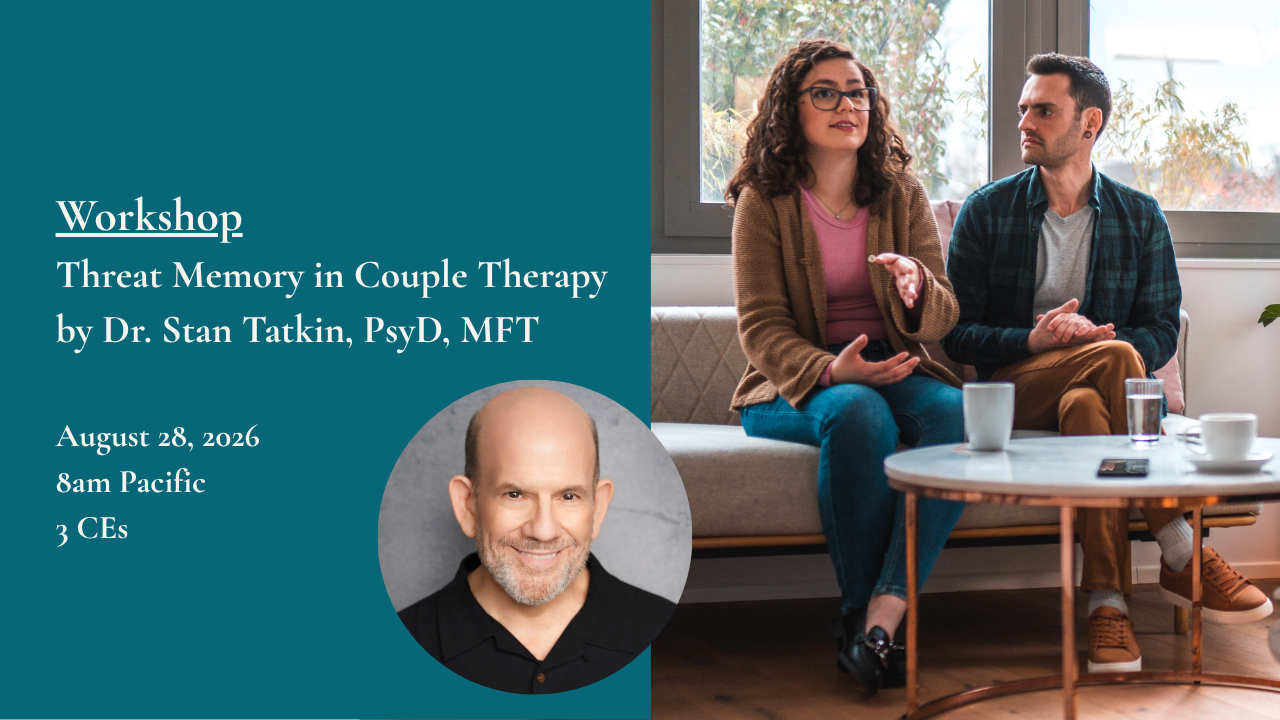
Live Workshop | Stuck in the Past: How to Move Forward When Threat Memory Hijacks Couple Therapy by Dr. Stan Tatkin, PsyD, MFT, founder of PACT
August 28, 2026 8:00am – 10:30am Pacific Time
Why do couples get stuck in the past? Couple therapy sessions get derailed when the past intrudes into the present. Old injuries, grudges, betrayals, misattunements, and unrepaired hurt become organized as living memory. The couple may sincerely want repair, yet the body keeps warning: don’t trust, don’t relax, don’t move on. Threat reactivity is a survival mechanism everyone carries. It's part of the human condition. Once you can see it clearly, you'll be able to help even your most "stuck" couples find a way through.
In this 2.5 hour workshop, PACT founder and developer Dr. Stan Tatkin will explore the neurobiology of threat, threat memory, pattern recognition, emotional regulation, and the couple as a self-reacting system.
Participants will learn how threat memory can make therapy feel intractable, why traditional rehashing of past events often deepens the loop, and how clinicians can help partners interrupt threat states before they take over the session.
Stan will offer practical ways to recognize when memory has hijacked the therapeutic process, stop the action, reset the couple’s state, and train partners to become better regulators of one another in real time.
You'll leave with a clearer model of what's actually happening in your clients' brains, and concrete tools to help them get unstuck. By the end of this workshop, participants will be able to:
- Describe how threat memory can intrude into present-moment couple interaction and interfere with repair, trust, and forward movement.
- Explain how pattern recognition, salience, negativity bias, and subcortical threat systems can lead partners to experience old danger as current reality.
- Identify clinical signs that a couple has entered a threat-memory loop rather than a productive repair process.
- Distinguish between working through the past and repeatedly re-litigating the past in ways that reinforce dysregulation.
- Apply state-regulation interventions to interrupt escalation, including stopping the action, slowing partners down, redirecting attention, and using brief reset procedures.
- Use co-regulation principles to help partners track each other’s face, eyes, voice, and body for signs of threat activation.
- Teach partners to prioritize each other’s state of mind over the content of the argument when threat begins to take over.
- Recognize why some betrayal cases become organized around the endless search for “what I still don’t know,” and how that search can become clinically paralyzing.
- Formulate stuck couple cases as two-person psychobiological systems rather than two separate individuals with competing narratives.
- Increase therapist self-regulation when working with highly threat-organized couples, including recognizing when the therapist’s own state is being pulled into the couple’s loop.
Plus These Great Benefits!
Can’t make it live? Purchase in advance to receive access to the workshop recording for 3 months. Note: The recording is only available if you register before the live event begins.
* CE credit is available for this workshop.
* No PACT training is required to attend.
* Become a PACTplus: Alumni Community member now to reserve your seat for FREE.
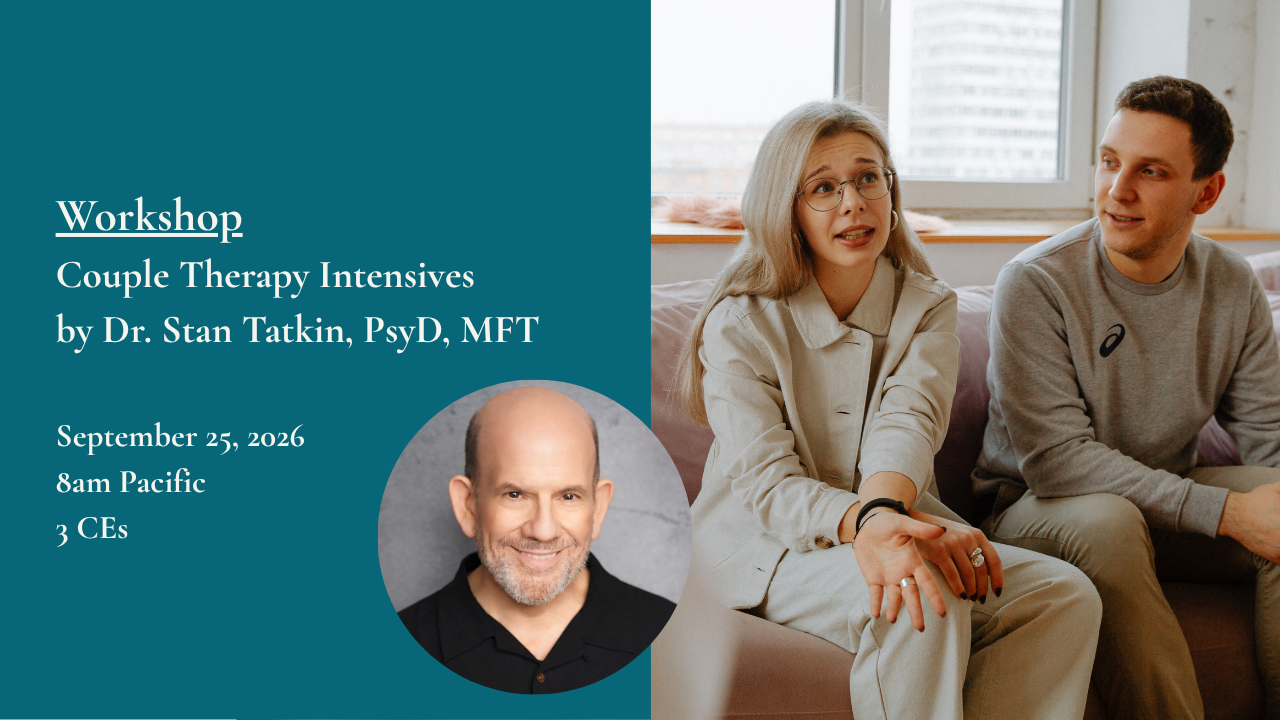
Live Workshop | Couple Therapy Intensives: Structure, Strategy, and Clinical Judgment for Rapid Assessment and Focused Intervention by Dr. Stan Tatkin, PsyD, MFT, Founder of PACT
September 25, 2026, 8:00 a.m.–10:30 a.m. Pacific Time
More time changes what is possible in the therapy room. Stan’s premise is simple: time spent equals influence. Extended, consecutive contact gives the therapist more opportunity to understand the couple’s system, observe patterns as they repeat, test clinical hypotheses, maintain momentum, and help partners rehearse new ways of functioning before they return to daily life.
A couple therapy intensive does not simply mean “more therapy.” It is a concentrated, assessment-driven, coaching-heavy clinical format organized around a specific, agreed-upon objective. The therapist must quickly determine what kind of case is actually in the room, what the couple is capable of doing, what requires immediate attention, and what the intensive can realistically accomplish.
Stan will describe the model he currently uses, particularly with couples traveling from out of town. This typically includes four consecutive days of approximately four hours each. He will explain why four hours functions as a practical fatigue and saturation limit (not as time the therapist must fill) and how clinicians can adapt the format without turning an intensive into several long, exhausting sessions.
This workshop will be taught through a PACT lens while translating its clinical principles for therapists from other couple therapy orientations. No previous PACT training is required. The goal is not to promise that a relationship will be repaired in several days. It is to accelerate assessment, case clarification, discovery, skill acquisition, decision-making, and movement toward a defined clinical objective.
Participants will leave with a practical map for assessing fit, setting expectations, structuring the work, using pressure without overwhelming the couple, avoiding therapist overactivity, and transitioning the couple into appropriate follow-up care.
What You’ll Learn
- How to structure and pace an intensive: Stan will describe his current four-day, four-hours-per-day model and discuss how to determine the number and length of sessions, plan breaks, manage fatigue, and conclude each day without oversaturating the couple.
- Rapid assessment and treatment planning: Learn how to conduct a focused initial interview, assess attachment, trauma, arousal regulation, and dyadic capacity, and identify the actual case type. These include betrayal, addiction, premarital, blended-family, decision, chronic-conflict, and mismanagement-of-thirds cases.
- The therapeutic container: Learn how to create focused, bounded tasks that place the couple under productive pressure, reveal how they function as a team, and assess their capacities for collaboration, mutual influence, regulation, error correction, and repair.
- Contraindications and red flags: Understand which couples may not be appropriate for an intensive, what must be stabilized first, and when violence, coercion, active substance use, psychiatric instability, severe dissociation, ongoing deception, or disorganized presentations require modification, postponement, consultation, or referral.
- What tends to go wrong: Stan will address fatigue, intervention overload, therapist performance pressure, and the commonly observed “day-two crisis”— when resistance, destabilization, or disappointment may intensify — and explain how to distinguish productive disruption from dangerous deterioration.
- Training and transitioning: Learn how to move beyond emotional processing and train partners in co-regulation, rapid repair, collaboration, rehearsal, and relationship self-governance. Stan will also discuss how to consolidate gains and return couples to an ongoing therapist or other appropriate care.
- The business side: Review realistic considerations involving scheduling, fees, deposits, cancellations, insurance limitations, therapist availability, and coordination with referring clinicians.
Can’t make it live?
Purchase in advance to receive access to the workshop recording for three months. The recording is available only if you register before the live event begins!
Plus These Great Benefits!
- CE credit is available for this workshop.
- No PACT training is required to attend.
- Become a PACTplus: Alumni Community member to reserve your seat for free.